

It’s no secret from my previous posts that I’m an open-source advocate. Throughout my career, I’ve put my money where my mouth is, investing in open-source companies such as ClickHouse* across AI and data infrastructure. I believe open-source players are an indispensable part of any tech stack, creating positive externalities across the ecosystem by accelerating innovation, lowering costs, increasing customization, and giving users greater transparency and control.
I first wrote about AI’s open-weight vs. closed-weight debate in 2023, offering support to scrappy open-source challengers taking on well-funded closed-source rivals. I framed it as “AI’s Linux moment” where open-source players could spur innovation, democratize AI access, and ultimately increase AI adoption.
The second chapter of this battle unfolded in 2024, in a year where open-source models were rapidly closing the capability gap with SOTA proprietary models. The debate also became more nuanced in 2024, with transparency, security, and regulation entering the conversation as the commercial stakes of the AI model wars grew.
Now it’s 2026, and the open-weight vs. closed-weight AI debate is back in the spotlight. But this time, geopolitics and global AI leadership are squarely at the center of conversation.
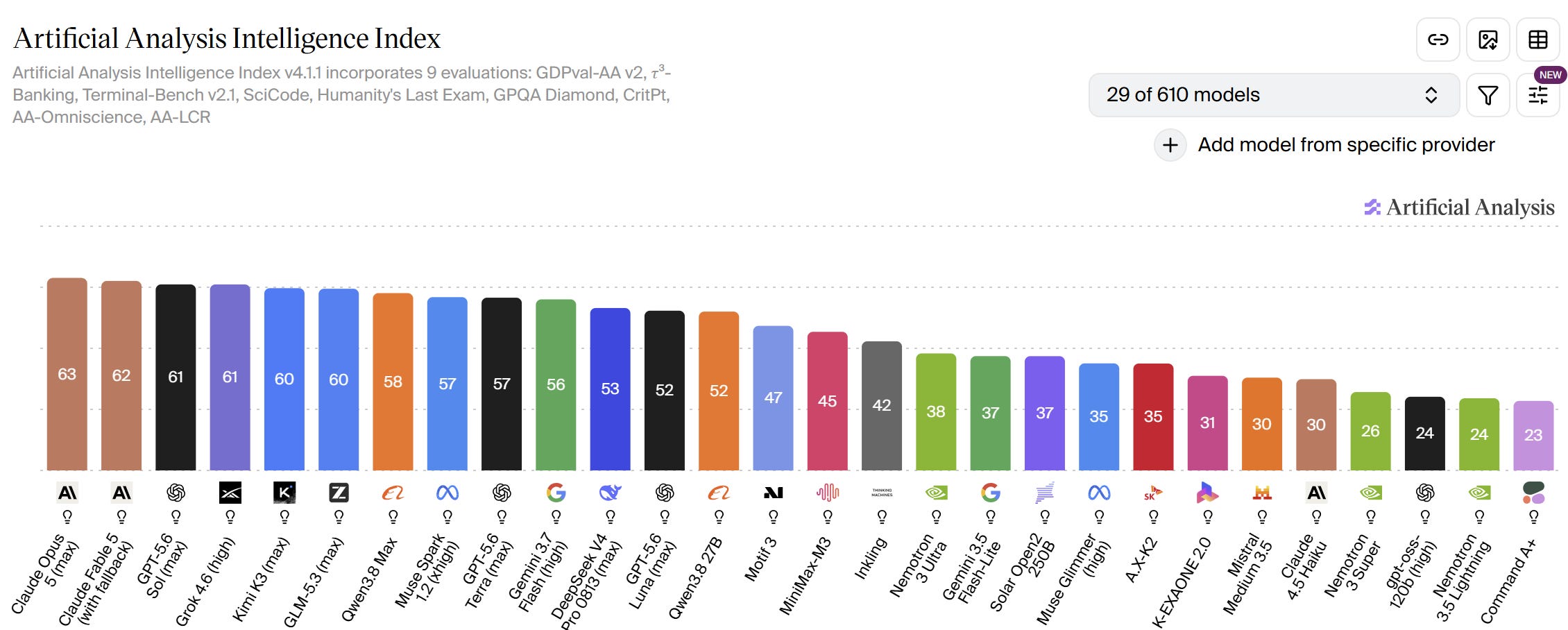
The debut of Kimi K3, an open-weight model from Chinese AI company Moonshot AI, took the world by storm in July. It quickly became the leading open-weight model globally with capabilities that placed it within striking distance of America’s leading closed-source frontier models (chart above). Its rise has sparked debates around the practice of distillation to close the frontier gap, as well as whether the government should restrict access to Chinese models.
A flurry of responses has ensued. Dean Ball of OpenAI suggested that “one probable outcome of an open-weight-model-dominant world is full AI communism”. Anthropic* published its own position on open-weight models. Even Jensen Huang of NVIDIA ‘entered the chat’ with his first-ever post on X addressing “Open Weights and American AI Leadership”:


America leads at the frontier with closed-source, but cannot risk falling behind in open-source
As seen in the first chart of this post, American models dominate the frontier, but they are overwhelmingly closed-source. Jamin Ball of Altimeter explored this gap in “Where Are the American Open Source Models?”, pointing to incentives, particularly from investors, as a major reason for the relative lack of American open-weight models.
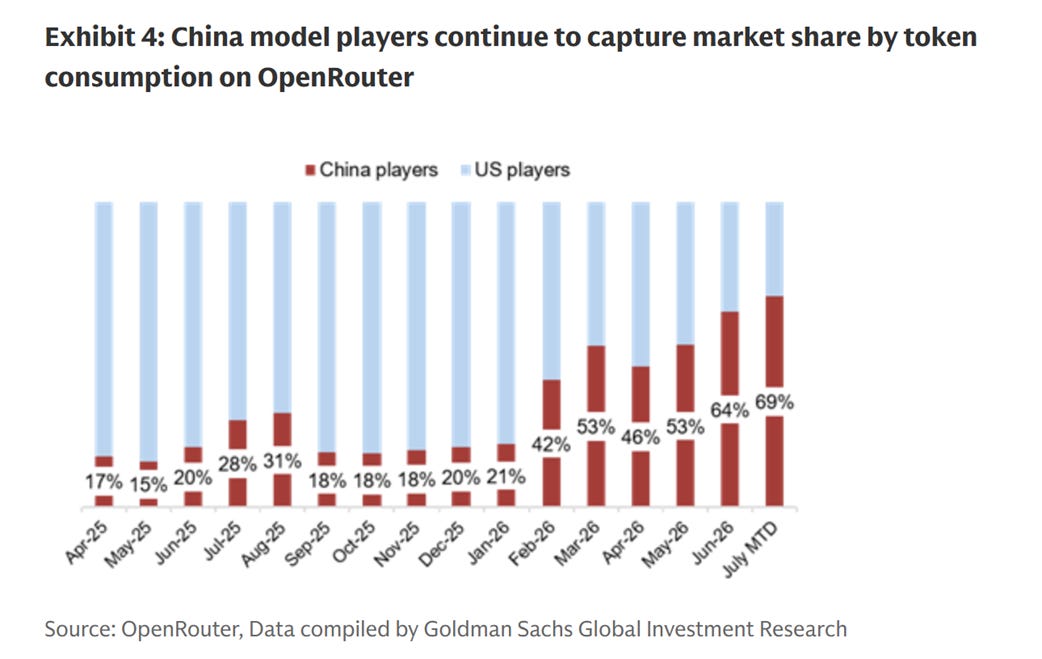
Chinese models including DeepSeek, MiniMax, Kimi, GLM, and Qwen, have increasingly filled the open-source AI leadership gap. The adoption of these models via their open-source leadership position is becoming increasingly visible in terms of downloads and token market share:
Who will be the bastion of American open-weight AI leadership?
While we should be proud of American exceptionalism at the closed-source frontier, ceding open-source leadership is not to be taken lightly since this domain is critical to the global AI race.
Open-weight models are becoming a meaningful part of how enterprises and developers build AI. Surveying 700 organizations across 41 countries, McKinsey found that 63% of respondents use open-source models, often alongside closed models from the frontier labs. Jesse Zhang of Decagon has also explained why Decagon is 90% open-source, proposing that open-source can be a better fit for mature use cases. Pinterest’s CEO Bill Ready went even further on the company’s most recent earnings call, saying that “any CEO that’s not taking advantage of open source models is almost certainly wasting a lot of their shareholders’ money”.
The stakes are too high to overlook the open-source AI domain. Given all the recent chatter, I’ve been thinking more deeply about what American open-source AI leadership could look like, and who will step up to shape its future.
Some have pointed to how the government can assert American open-source AI leadership through active means such as procurement and direct contributions to open-source innovation, rather than reactive restrictions or bans on open-source development.
Academia could play an important role too. As in previous paradigms like data infrastructure, we’ve already seen academic researchers make significant contributions to the open-source AI ecosystem through projects like DSPy (shoutout to my alma mater Stanford and Bigspin.ai*’s Professor Chris Potts)!
But in my view, the biggest opportunity lies with a group of “unusual suspects”: the hyperscalers and Big Labs. Returning to Ball’s point on incentives: these players may have the strongest motivations to cultivate a thriving American open-weight ecosystem. And the timing is telling. Within weeks of Kimi K3’s debut, several moved decisively to bolster America’s position in open weights:
NVIDIA: NVIDIA monetizes the picks and shovels of AI, namely compute and infrastructure. More capable open-weight models could drive greater AI adoption, which ultimately expands demand for compute and feeds NVIDIA’s core business. It is therefore no surprise that Jensen Huang has been so vocal about the importance of open weights. NVIDIA has also become increasingly active in the open-source ecosystem through initiatives like Nemotron, including the release of Nemotron 3.5 Lightning last week.
Meta: As a vertically integrated platform with core businesses in areas such as social media and advertising, Meta has an outsized interest in providing capable open-source offerings that can drive attention, engagement, and retention across its ecosystem. Meta was, in fact, an early mover in American open-source AI with its Llama family of models. While the company moved toward closed models with the launch of Muse Spark 1.1, it has now returned to its open-source roots with renewed force over the past week: releasing open weights for Muse Glimmer, announcing an upcoming open-weight version of Muse Spark 1.2, and publishing “The Future Is for Everyone” to reaffirm its commitment to open-source.


Show me the incentives and I’ll show you the outcome
I highlight NVIDIA and Meta because their recent moves are big wins for American open-weight AI leadership, but they are far from alone. Other hyperscalers are contributing to the open-weight ecosystem too, including Google with its Gemma efforts.
There is, of course, a broader debate around concentration of power as a handful of big companies take on increasingly influential roles across the AI ecosystem. But overall, I believe in American innovation and I’m optimistic that American open-weight AI champions will continue to grow in both number and diversity, particularly as more startups find strategic incentives aligned with the open-weight ecosystem. For example, the growing cohort of model-agnostic inference platforms have clear incentives to see this ecosystem grow, as more capable and diverse models should ultimately translate into more inference demand.
Additionally, many Chinese open-weight labs have recently announced various monetization initiatives to capitalize on their rapid adoption. As these business models prove out, they could materially change the mindset of American startups and investors toward the commercialization potential of open-weights. Neolabs like Thinking Machines are already exploring this path, having open-sourced its first product-grade AI model Inkling just last month.
And finally, perhaps all this momentum will ultimately inspire the American frontier labs to join the charge. Rather than keeping every model behind closed doors, they could consider open-sourcing earlier generations to drive ecosystem adoption and keep users within their orbit.