

More than a dozen space companies have entered the public markets since 2020. AST SpaceMobile, Rocket Lab, Planet Labs, Firefly Aerospace, and Voyager Technologies are among those who have collectively marked one of the most consequential listing cycles in the history of commercial space. But the pièce de résistance came this month: SpaceX’s IPO, the largest IPO in history with a $1.77T valuation to match, re-cemented the industry’s arrival on the global stage in a way no other event could.
Much like Netscape’s IPO ushered in the dawn of the internet era, SpaceX’s listing is less a culmination of the commercial space story and more a catalytic ‘Big Bang’ event that could ignite the next multi-trillion-dollar chapter for the Space Economy:
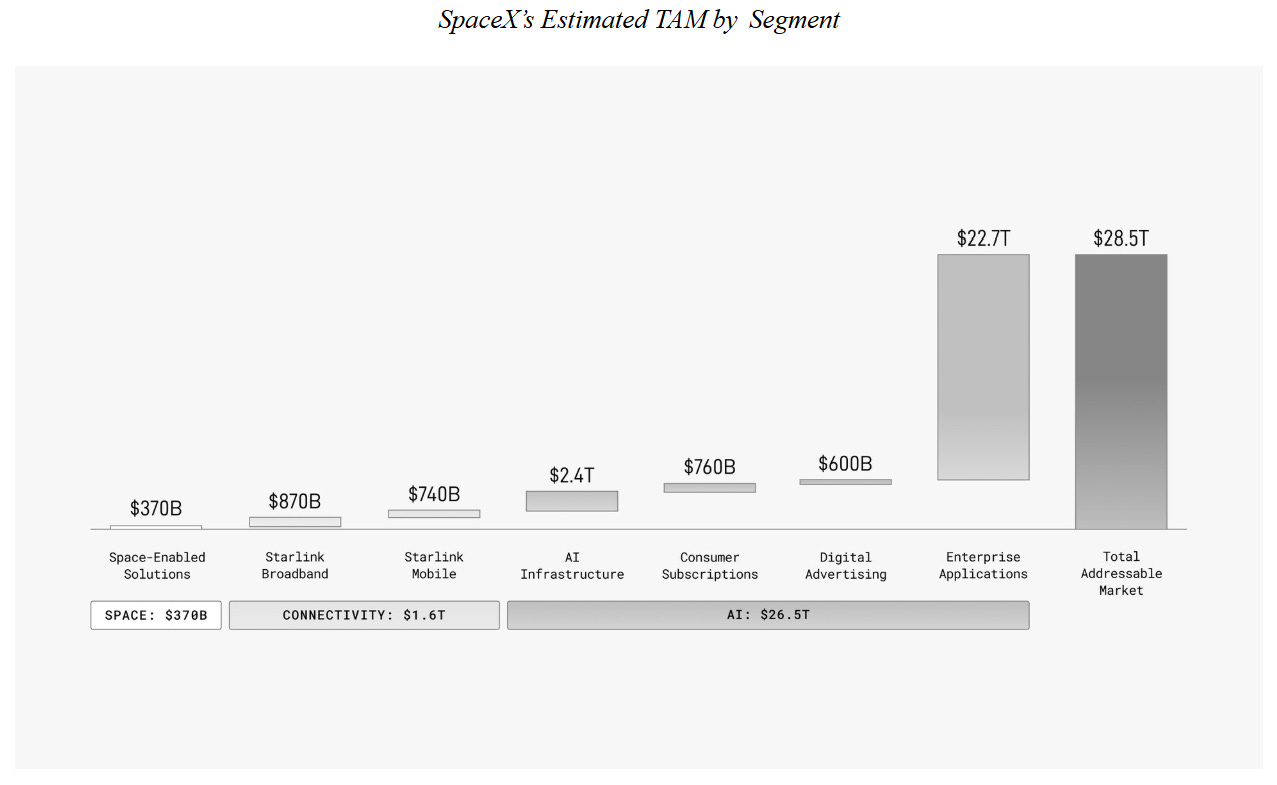
How did we get here?
In 2018, my colleague David Cowan published Bessemer’s Space Stack Roadmap, where he observed that technology and market conditions were aligning to allow “space to be open for business”. Since then, the industry has not merely achieved lift off; it has reached escape velocity, driven by powerful tailwinds that continue to propel it to new heights:
Launch is easing as a bottleneck: For decades, access to space was constrained by rocket programs optimized for large, bespoke payloads destined for geosynchronous orbit. Missions often required years of advance planning with five to ten years of lead time, making launch capacity scarce, expensive, and one of the primary limiting factors on the growth of the Space Economy. Today, that paradigm has been fundamentally reshaped by companies like Rocket Lab and SpaceX, whose innovations now allow for dramatically cheaper and more frequent launch cadence to low earth orbit. As the price of access to space continues to fall, entirely new space markets become economically viable, expanding the frontier of what can be built, operated, and commercialized in orbit.
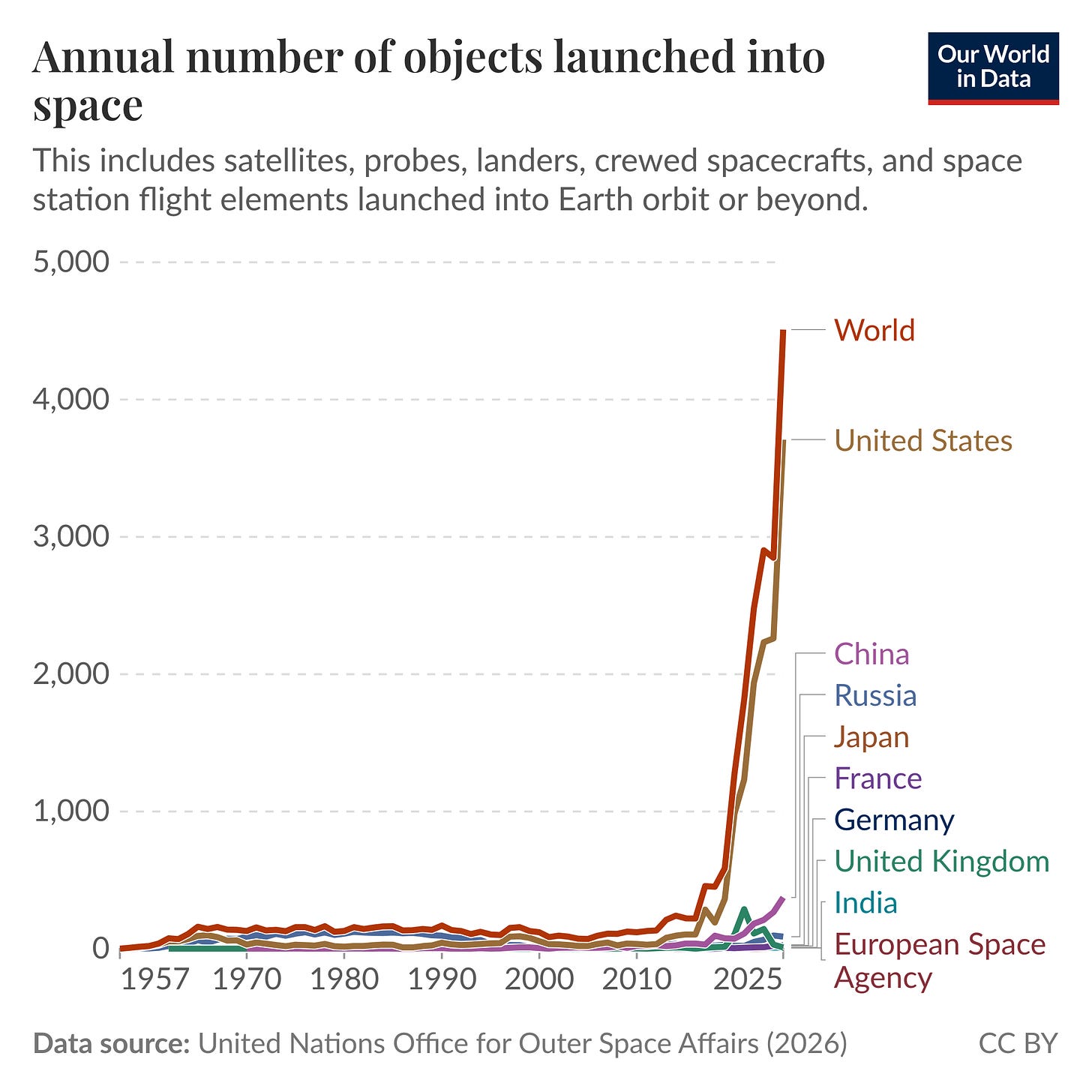
Source: Our World in Data, “A record number of objects went into space in 2025” (3/3/26)
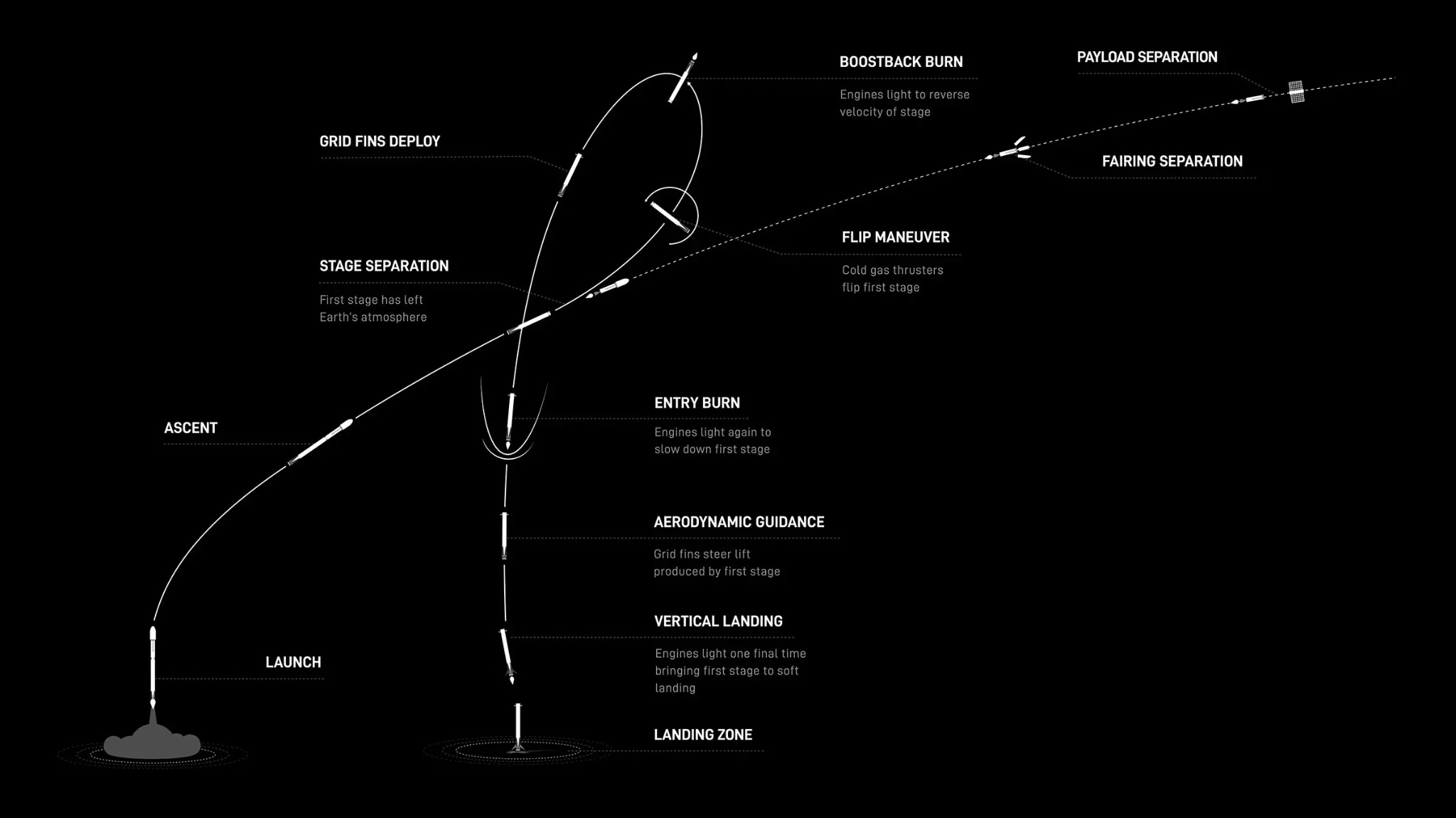
Technology breakthroughs are transforming space economics and capabilities: The pace of innovation in the industry has accelerated dramatically since 2018, fundamentally changing cost structures and mission capabilities of space technologies. For instance, related to preceding point on cheaper launch democratizing space innovation, reusability is now a proven reality (see Falcon 9 exhibit below) rather than a bold aspiration. At the same time, advances in computing, miniaturization, COTS manufacturing, and CubeSat architecture have sparked an explosion of orbital traffic and satellite networks. Layer on the rise of AI, which has the potential to enable unprecedented autonomy, analytics, and operational efficiency, and the result is an industry capable of achieving what would have seemed impossible just a decade ago.
Space is now a consequential contested domain: As space becomes more crowded, it is also becoming more contested. As my colleagues and I highlighted in Bessemer’s 2026 Defense Tech Roadmap and Bessemer’s 2025 European Resilience Roadmap, space is shifting from a frontier of exploration to a critical theatre for national security and economic competitiveness, with recent initiatives such as The Golden Dome for America and DARPA’s Rapid Reconstitution of Space Capabilities underscoring the urgent need for space sovereignty.
Space has re-entered the cultural and commercial zeitgeist: Public fascination and enthusiasm for space have reached levels not seen since the Apollo era as government and commercial interest converge into simultaneous goals. For instance, NASA’s Artemis program has rekindled humanity’s ambitions for lunar exploration, while Blue Origin’s New Shepard and other commercial missions have brought the promise of civilian spaceflight and space tourism into the public consciousness. Together, these developments have propelled space from a niche frontier into the mainstream.
Private capital is flooding into space tech: The recent blockbuster successes of venture-backed space leaders in the public markets have catalyzed an unprecedented influx of private capital into space startups to fuel innovation — the WSJ reports that venture funding for U.S. space-technology firms (excluding SpaceX) shot up to $7.1Bn in 2025 from $2.5Bn a year earlier.
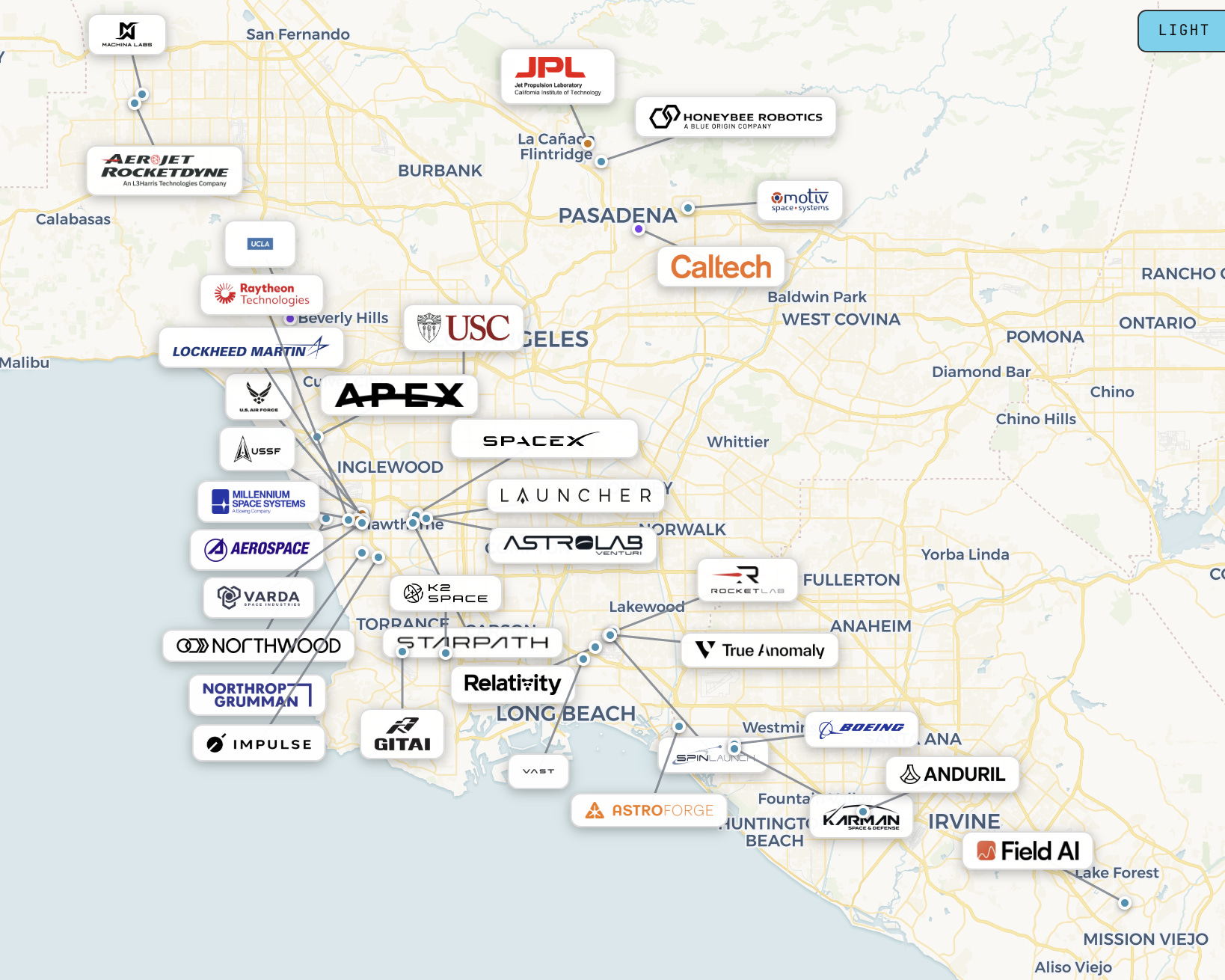
The talent ecosystem is growing: The surge of capital and interest flowing into the space industry has created compounding effects that increase talent density and knowledge transfer, powering a vibrant ecosystem of space builders. For instance, Southern California now houses the highest concentration of aerospace and space-robotics organizations on Earth:
The Space Economy enters its next trajectory
The first generation of space founders didn’t just launch rockets; they launched an entire industry. These pioneers were very much focused on proving that space tech, including vectors such as launch, communications, satellites, and data, were viable and not just science experiments. The foundation that they’ve built is now load-bearing to support the next generation of builders pushing the final frontier. The maturing vectors of the Space Economy are now core infrastructure enabling emerging vectors such as:
Autonomy and AI that can transform what spacecraft can do once they reach orbit
Novel space services including exploration, logistics, mining, monitoring, and awareness
Space operators around tourism, habituation, and cargo transport
In-orbit energy and compute such as data centers in space
Materials, components, and manufacturing including facilities on the Moon or Mars
Ad astra!